Saturday, 6 April 2013

The Portrait

Many years back I was sitting in the office of my Sensei (I teach and practice a martial art called Aikido). I had asked for a meeting and I told him I needed to stop training. Times were tough and I wasn't selling a lot of artwork. I loved Aikido but it just wasn't financially viable at the time.

He knew how dedicated a student I was, but he understood my predicament. He proposed a commissioned portrait for a years worth of mat fees. I had mixed emotions. I wanted to keep training, but portraits intimidated me. I offered to do a big landscape instead. He wanted a portrait. I reluctantly agreed.

I had been drawing portraits since I was five I think. I had The Beatles, White Album. It had these nice big 8x10's of the band. I used to draw them and my mom would critique them. I would draw comic characters and pretty much anything that interested me. In high school I even had some cartoons published in the local newspaper. With a pencil in my hand I was confident, but paint was another story.

I started painting while I was an amateur athlete. I was a long track speed skater. I also attended the local art college. I was part of the painting faculty. There were almost no fundamentals taught when I was there. I hope that's changed. What I did learn was that I was completely on my own to learn, so that's what I did. When my body said it was time to move on from skating, I got gallery representation and never looked back. I did mostly landscapes. I got into a pattern where I would design and idealize to suit my needs. When the time came to represent something faithfully I had a lot of trouble.

I'm not sure exactly, but Sensei's portrait may have been the catalyst for the "big change", much like the big bang except there was matter beforehand and no real sound...

I did the portrait and it was awful! Really, really bad. I had no clue what I was doing. Here I was, supposed to be a professional artist and I was stumped.

 He hated the portrait and so did I. He wanted me to redo it, so did I. Sensei was very compassionate, he never pressured me to finish it.

Then he had a stroke and five months later he died.


Classroom scene. Sensei like it but he wanted to see his face.


Although I tried, I never held up my end of the bargain.

Around this time I found Richard Schmid and Jeremy Lipking. I just stumbled onto their work. Living artists that could could paint beautiful realistic paintings! Through them and their paintings I also rediscovered John Singer Sargent, Zorn and Sorolla. I started to really study all their work and I got Richard's Book, Alla Prima: Everything I know About Painting. It just made total sense. I followed it to the letter. I also got Jeremy's book and DVD. Later I went to visit Jeremy and take a workshop.

It was an exciting time. By exciting I mean dreadfully scary and frustrating. In Richard's book he states you should never leave anything on your canvas that you know is wrong. So that became my personal credo. My ultimate goal was to be able to sit down in front of anything and represent it faithfully.

On top of all this I became a father and a stay-at-home dad. I decided I wanted to reinvent myself as an artist and change everything. With my limited time I went into the studio and began practicing. I wanted to finish the portrait I started. I thought that we should have a visual memory of Sensei in the dojo while we practiced. So I collected all of the reference material I had of Inaba Sensei and I began.

I must have done that portrait sixty or seventy times. I finally got to the point where I was satisfied.

We now hang the portrait up when we practice. It's a nice little memory of Sensei to the students who knew him. It also gives the new students a visual of the man that brought Aikido to Calgary.

To me it's so much more than a painting. It's a reminder of struggle, perseverance, failure, loss, gain, success and also how much farther I have to go. I see things that I could of done better, although it was my best effort at the time...


Inaba Sensei

Tuesday, 25 December 2012

Painting Over A Stinker: Or, Third Time's A Charm


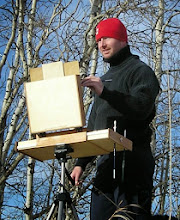
In this post I will take you through a Plein Air session. I am going to use a method of painting over a stinker (failed painting)...


You have them. So do I. Everyone that paints does too. Not everything we do comes out the way we intended. The best you can do is try, play, fail, learn and keep going. I don't get as frustrated as I used to. (if you do get insanely frustrated I recommend a good panel-they skip across the lake nicely).

This particular demo is on a panel I made from mahogany door skin that I made. It's sized and at least triple lead primed. The stinker on there is a still life that never went anywhere.


If your stinker is fairly wet you can just rub it off. This one was dry. I chose to sand it down a bit, just to get rid of the ridges. I use the stinker sometimes to show through in places if there is an opportunity.


Next I clean it off, wipe it down and it's ready to go!


It's a gorgeous day. No wind. There is an eerie calm we get sometimes with a chinook in this part of Alberta, Canada. I find a good spot and set up.


I know it's going to be a fairly cool painting so I make a decision to have a warm underpainting. I put on a burnt sienna/turpentine wash. I use turpentine so it'll set up faster. I also prefer the feeling of painting over this initial wash. I want to be able to have both the warm and the old painting coming through in spots. I generally do this right away, before I have set out my palette.


Next, I eat. I have been out for awhile hiking and scouting. I like to think I am ready for anything. I get into some precarious spots sometimes so if I get stuck without food, water or warmth, bad on me. On my breaks I scout out other close by areas. One time, I fell through the ice up to my shoulders. Stupidly, I painted for another hour after that. In my defence, I had already started painting and had a good one going. I slept well that night...


Anyway, getting back- This also allows time for the wash to set up. I make sure I've set out the palette, get everything ready to go so I can just focus, and I start.


I figure out what I want to get in the scene. Sit there and observe. Next I get my darkest dark, the big shapes and most of the composition sorted out.


Now I work on the focal point of the painting. I work back and forth sort of like doing a puzzle. Mostly working out the areas adjacent to each other; comparing their colour, values and edges. Not really finishing as I go but close enough to move on.


The focal point is now blocked in and for the most part what I want.


I add most of the mid ground colour, leaving warm bits throughout to create a harmony. This stage is fairly loose because most of the snow in the shade is is similar in colour and value.


It's getting close to the end now. I get into the snow that is in the light.


Union rules stipulate it's time for coffee. I get up, stretch, walk around and not look at the painting for a little while. The light is fairly consistent so I'm not worried about losing it. When I come back I clean the palette, (which I have done frequently throughout). Now I'm ready to finish it up!


I put in the final highlights, some knife-work in the foreground. both of which I leave pretty thick. This is all I really came here for so I sign it, pack everything up and call it a day.